
Effects of Consuming Animal Products on Health
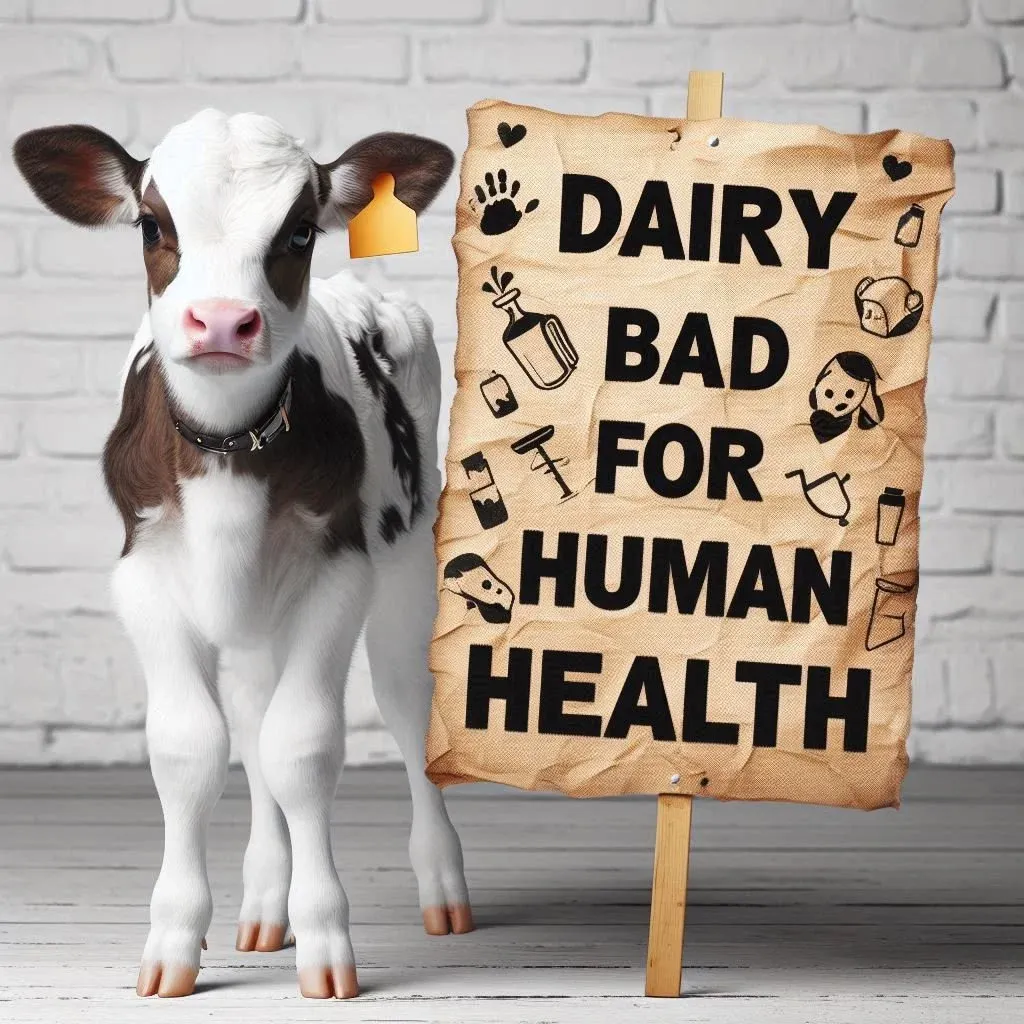
Consuming animal products, including dairy has been consistently shown to have adverse impacts on human health [Scroll to the end for the references used for this article].
Additionally, early studies show benefits of vegan diets, beyond vegetarian diets, in all causes of mortality, cancer, and cardiovascular mortality.
-
Vegans have decreased total cholesterol, LDL, glucose levels, and BMI, less incidence of and mortality from cardiovascular disease and 8% less cancer incidence. Vegans have 15% less cancer incidence than the general population.
-
Plant based diets have benefits for prevention of cardiovascular disease, stroke, hypertension and obesity.
-
Unhealthy components of dairy products include saturated fat, lactose, galactose, estrogen hormone, insulin-like growth factor, and other antibiotics.
Life-threatening risks
Those who consume animal products have a higher risk of death from all causes, while those consuming mostly plant protein have a lower risk of dying from all causes, as well as specifically from cardiovascular disease and dementia. Milk and milk products are considered animal products. Their effects on the body are similar to meat, not like other plant sources of food.
-
There is no benefit of dairy products on bone density, and many studies show harms.
-
The effects of whole milk are especially detrimental.
Cancer
-
Breast and ovarian cancers are associated with dairy product consumption in women.
-
Milk consumption, especially with high fat content, is associated with an increase in breast cancer (and soy product intake with a decrease in breast cancer risk) and dying from breast cancer.
-
Consuming lactose and dairy products is linked to the risk of ovarian cancer.
-
There is also a strong body of evidence linking milk consumption to prostate cancer in men.
-
Men who were vegan had less prostate cancer compared to those who were non-vegetarian (including those who were lacto-ovo vegetarian) in a study of Seventh-Day Adventists and in the European Prospective Investigation study.
-
In a prospective study, it was found that high consumption of milk in adolescence led to a threefold risk of advanced prostate cancer later in life.
-
A larger meta-analysis confirmed the association between dairy intake and prostate cancer, and moreover showed that non-dairy sources of calcium, such as plant milks, kale, and broccoli, have protective effects.
-
Even after a prostate cancer diagnosis, men who consumed the most (three or more servings) dairy products had a higher risk of dying from all causes or from prostate cancer compared to those who consumed less than one dairy product per day.
-
A study of male physicians confirmed that whole milk increased the risk of dying from prostate cancer.
Diabetes
- Plant-based diets have been shown to be effective in preventing and treating Type 2 diabetes.
Dementia and Cognitive Impairment
-
The risk of Alzheimer’s dementia is associated with meat, eggs, and high-fat dairy products. Some consider it a disease affecting the blood vessels of the brain, with the same harmful effects in the brain as these products have on the blood vessels of the heart.
-
Men and women eating the most dairy had higher rates of Parkinson’s disease.
Hypertension
- Vegans have lower blood pressure than vegetarians and meat-eaters, with body mass index associated in one study but not in another.
Fractures
- Total calcium intake is important, but dairy consumption is not associated with a decreased risk of fractures.
BMI
- Vegans had the lowest Body Mass Index compared to lacto-ovo, pesco, semi, and non-vegetarians.
Children
- For children and infants, allergies, constipation, and lactose intolerance are all associated with dairy consumption.
References
-
Harris, W. S., & LaCroix, A. Z. (2014). Beyond meatless, the health effects of vegan diets: Findings from the Adventist cohorts. Nutrients, 6(10), 2131-2145. http://www.ncbi.nlm.nih.gov/pmc/articles/PMC4073139/pdf/nutrients-06-02131.pdf
-
Micha, R., Peñalvo, J. L., Cudhea, F., & Rehm, C. D. (2016). Vegetarian, vegan diets and multiple health outcomes: A systematic review with meta-analysis of observational studies. Critical Review of Food Science Nutrition. https://www.ncbi.nlm.nih.gov/pubmed/26853923
-
Journal of Geriatric Cardiology. (2017). Special issue regarding plant-based diets. Journal of Geriatric Cardiology, 14(5). https://www.ncbi.nlm.nih.gov/pmc/issues/293850/
-
Li, Y., Pan, A., Wang, D. D., & Liu, X. (2021). Association of major dietary protein sources with all-cause and cause-specific mortality: Prospective cohort study. Journal of the American Heart Association, 10(19), e015553. https://www.ahajournals.org/doi/10.1161/JAHA.119.015553
-
American Journal of Clinical Nutrition. (2009). Should dairy be recommended as part of a vegetarian diet? American Journal of Clinical Nutrition, 89(5), 1638S-1642S. http://ajcn.nutrition.org/content/89/5/1638S.full
-
Vang, A., Singh, P. N., Lee, J. W., & Hiller, L. D. (2005). Calcium, dairy products, and bone health in children and young adults: A reevaluation of the evidence. Pediatrics, 115(6), 1812-1819.
-
Tucker, K. L., Hannan, M. T., & Qiao, N. (2019). Associations of dairy intake with risk of mortality in women and men: Three prospective cohort studies. BMJ, 367, l6204. https://www.bmj.com/content/367/bmj.l6204
-
Largent, J. A., Lee, J. S., & Park, Y. (2020). Dairy, soy, and risk of breast cancer: Those confounded milks. International Journal of Epidemiology. https://academic.oup.com/ije/advance-article/doi/10.1093/ije/dyaa007/5743492
-
Key, T. J., Appleby, P. N., & Allen, N. E. (2015). Are strict vegetarians protected against prostate cancer? American Journal of Clinical Nutrition, 101(5), 1044-1052. http://www.ncbi.nlm.nih.gov/pubmed/26561618
-
Johnsen, N. F., Christensen, J., & Kjøller, M. (2004). Animal foods, protein, calcium, and prostate cancer risk: The European Prospective Swedish Mammography Cohort. American Journal of Clinical Nutrition, 80(5), 1353-1357. https://www.ncbi.nlm.nih.gov/pmc/articles/PMC2391107/?tool=pubmed
-
Wu, K., Willett, W. C., & Fuchs, C. S. (2012). Milk intake in early life and risk of advanced prostate cancer. American Journal of Epidemiology, 175(11), 1157-1166. http://www.ncbi.nlm.nih.gov/pmc/articles/PMC3249408/
-
Aune, D., Norat, T., & Romundstad, P. R. (2015). Dairy products, calcium, and prostate cancer risk: A systematic review and meta-analysis of cohort studies. American Journal of Clinical Nutrition, 101(5), 1044-1052. https://www.ncbi.nlm.nih.gov/pubmed/093/ajcn/80.5.1353
-
Fink, A., & Elkan, R. (2015). Dairy intake after prostate cancer diagnosis in relation to disease-specific and total mortality. International Journal of Cancer, 137(7), 1614-1623. https://www.ncbi.nlm.nih.gov/pmc/articles/PMC4754664/
-
Chiu, C. K., & Hsu, C. K. (2013). Whole milk intake is associated with prostate cancer-specific mortality among U.S. male physicians. Journal of Nutrition, 143(8), 1187-1194. https://www.ncbi.nlm.nih.gov/pmc/articles/PMC3542910/
-
Journal of Geriatric Cardiology. (2017). A plant-based diet for the prevention and treatment of type 2 diabetes. Journal of Geriatric Cardiology, 14(5). https://www.ncbi.nlm.nih.gov/pmc/articles/PMC5466941/; Trapp, C. B., & Barnard, N. D. (2010). Usefulness of vegetarian and vegan diets for treating type 2 diabetes. Current Diabetes Reports, 10(2), 152-158.
-
Gao, X., & Qi, L. (2016). Using multicountry ecological and observational studies to determine dietary risk factors for Alzheimer’s disease. Journal of the American College of Nutrition, 35(5), 383-389. https://www.ncbi.nlm.nih.gov/pubmed/27454859
-
Zhang, S. M., & Manson, J. E. (2007). Consumption of dairy products and risk of Parkinson’s disease. American Journal of Epidemiology, 166(8), 878-885. http://www.ncbi.nlm.nih.gov/pubmed/17272289
-
Orlich, M. J., & Fraser, G. E. (2012). Vegetarian diets and blood pressure among white subjects: Results from the Adventist Health Study-2 (AHS-2). Public Health Nutrition, 15(6), 1126-1134. http://www.ncbi.nlm.nih.gov/pmc/articles/PMC3443300/
-
Appleby, P. N., & Key, T. J. A. (2002). Hypertension and blood pressure among meat eaters, fish eaters, vegetarians, and vegans in EPIC-Oxford. Public Health Nutrition, 5(6), 645-654. https://pubmed.ncbi.nlm.nih.gov/12372158/
-
Journal of the American Medical Association - Pediatrics (JAMA). (2014). Milk consumption during teenage years and risk of hip fractures in older adults. JAMA Pediatrics. https://jamanetwork.com/journals/jamapediatrics/fullarticle/1896260; Appleby, P., Roddam, A., Allen, N., & Key, T. (2007). Comparative fracture risk in vegetarians and nonvegetarians in EPIC-Oxford. European Journal of Clinical Nutrition, 61(12), 1400-1406. doi:10.1038/sj.ejcn.1602659
-
Micha, R., Peñalvo, J. L., & Cudhea, F. (2013). Nutrient profiles of vegetarian and non-vegetarian dietary patterns. Journal of the Academy of Nutrition and Dietetics, 113(5), 711-721. http://www.ncbi.nlm.nih.gov/pmc/articles/PMC4081456/
-
Sampson, H. A. (2004). Update on food allergy. Journal of Allergy and Clinical Immunology, 113(5), 805-819. https://doi.org/10.1016/j.jaci.2004.03.014
-
Host, A. (2002). Frequency of cow’s milk allergy in childhood. Annals of Allergy, Asthma & Immunology, 89(6 Suppl 1), 33-37. https://doi.org/10.1016/s1081-1206(10)62120-5
-
Iacono, G., Cavataio, F., Montalto, G., et al. (1998). Intolerance of cow’s milk and chronic constipation in children. New England Journal of Medicine, 339(16), 1100-1104. https://doi.org/10.1056/NEJM199810153391602
-
Dehghani, S. M., Ahmadpour, B., Haghighat, M., Kashef, S., Imanieh, M. H., & Soleimani, M. (2012). The role of cow’s milk allergy in pediatric chronic constipation: A randomized clinical trial. Iranian Journal of Pediatrics, 22(4), 468-474. https://doi.org/10.5812/ijp.5918